


NVIDIA
RTX 50RTX 5070
Blackwell · 2025
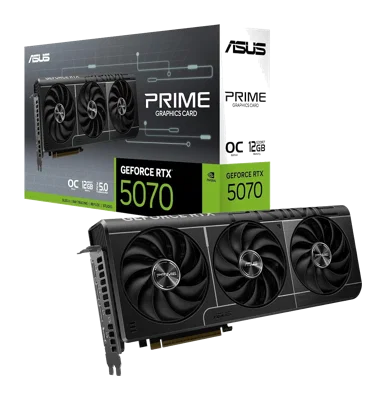
- VRAM
- 12 GB GDDR7
- Bus
- 192 bits
- Power draw (TDP)
- 250 W
- Cores
- 6,144 CUDA
- Upscaling
- DLSS 4
- Blender (3D render)
- 5,794 samples/min
- Launch MSRP
- $549.00
$856.99
at Amazon
Graphics cards
The current generation's two upper-midrange graphics cards, with the same official launch price ($549). The RTX 5070 comes with 12 GB of GDDR7 and the RX 9070 with 16 GB of GDDR6.
RTX 5070
Pick it if…
You use creative software (Blender, local AI, CUDA-accelerated editing), want DLSS 4 with Multi Frame Generation, or play a lot with ray tracing.
RX 9070
Pick it if…
You want more VRAM for high-res textures and future games, plus slightly lower power draw (220 W vs 250 W).
Note. MSRP is the recommended launch price, not the current price. There are no GPU benchmarks on the site yet: the table compares specifications.
Warning. CUDA cores (NVIDIA) and stream processors (AMD) can't be compared across brands: they are different architectures. That's why those rows aren't highlighted.
Blackwell · 2025
$856.99
at Amazon
RDNA 4 · 2025
$719.99
at Amazon
| Specification | RTX 5070 | RX 9070 |
|---|---|---|
| Memory | ||
| VRAM | 12 GB | 16 GB (best value in this row) |
| Memory type | GDDR7 | GDDR6 |
| Memory bus | 192 bits | 256 bits (best value in this row) |
| Memory bandwidth | Data not available | Data not available |
| Compute | ||
| CUDA cores (NVIDIA) | 6,144 | Data not available |
| Stream processors (AMD) | Data not available | 3,584 |
| Compute units (AMD) | Data not available | 56 |
| Boost clock | Data not available | Data not available |
| Measured performance | ||
| Blender (3D render, samples/min) | 5,794 (best value in this row) | 3,008 |
| Power | ||
| Power draw (TDP) | 250 W | 220 W (best value in this row) |
| Features | ||
| Ray tracing | Yes | Yes |
| RT generation | Gen 4 | Data not available |
| AI hardware | Tensor Cores | AI Accelerators |
| Image upscaling | DLSS 4 | FSR 4 |
| Frame generation | Yes | Data not available |
| General | ||
| Architecture | Blackwell | RDNA 4 |
| Release year | 2025 | 2025 |
| Launch price (MSRP) | $549.00 | $549.00 |
| Best current price | $856.99 | $719.99 (best value in this row) |
VRAM
Memory bandwidth
Blender (3D render)
Power draw (TDP)
Launch price (MSRP)
Blender: source Blender Open Data (Dominio público (datos abiertos de la Blender Foundation)), Blender 5.2.0 LTS, data from 06/10/2026. It measures 3D rendering with Cycles, not gaming performance.
Video tests of this combination. FPS depends on the GPU, the games and the settings of each test.
Channel: Daniel Owen
Watch on YouTube (opens in a new tab)Channel: Artur Tran
Watch on YouTube (opens in a new tab)Channel: Jegs TV
Watch on YouTube (opens in a new tab)Incluye RTX 5070
Channel: Canal por verificar
Watch on YouTube (opens in a new tab)Incluye RTX 5070
Channel: Canal por verificar
Watch on YouTube (opens in a new tab)Some results come from an automatic YouTube search: make sure they are what you're looking for.
Want to see more? Search on YouTube
16 GB vs 12 GB is the most visible difference. In recent games with maxed-out textures at 1440p or 4K, 12 GB can be tight in some titles; 16 GB gives more headroom over the long term. The 5070 partly makes up for it with GDDR7 memory, which is faster per bit.
NVIDIA offers DLSS 4 with Multi Frame Generation and traditionally stronger ray tracing. With RDNA 4, AMD debuts FSR 4, its first AI-based upscaler, and greatly improved ray tracing over the previous generation.
In Blender (Blender Open Data results in the chart below) the RTX 5070 performs almost twice as fast as the RX 9070, thanks to CUDA and OptiX. Reference power draw is 250 W for the NVIDIA card and 220 W for the AMD card.
Based on official catalog specifications. Prices change: check the table, which shows the date of each price.